
Welcome to the ITIV
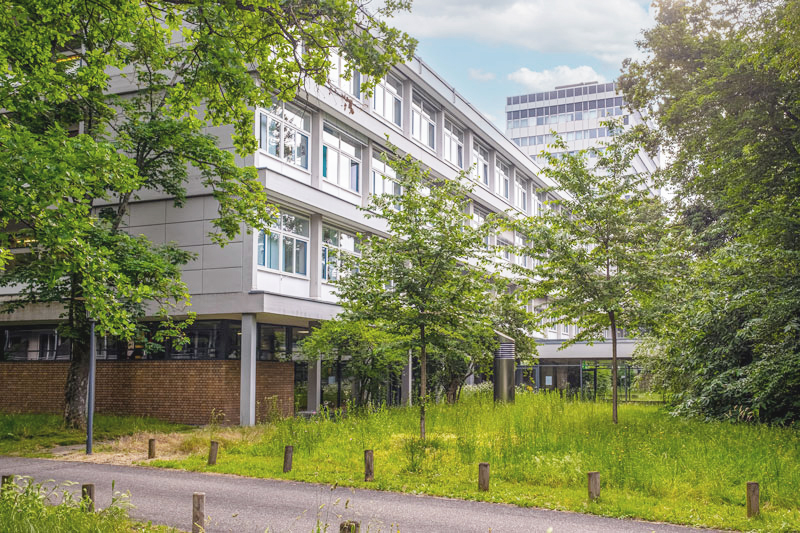
The Institut für Technik der Informationsverarbeitung (ITIV) is one of the sixteen laboratories of the KIT Department of Electrical Engineering & Information Technology of the KIT.
The institute concentrates - in research and teachings - on methods and computer aided tools for the design of electronic systems and microsystems.
The ITIV is managed in collegial responsibility by

Five electrical engineering undergraduate students at KIT have developed a smart, wireless door sign at ITIV. The energy-efficient prototype, featuring an E-Ink display, Wi-Fi connectivity, and Outlook integration, displays room occupancy status and will even allow users to book rooms on the spot in the future.
Read more here...
This year's graduate student seminar held by Prof. Becker's research group in Monbachtal focused on academic exchange and the presentation of current research projects. Team spirit was also strengthened through the collaborative building and testing of a raft.
All the details here...
Marvin Gerold Feil has successfully completed his dissertation, “Design and Recording Methods for Holographic Waveguide Displays.” He was awarded the highest distinction, “summa cum laude,” for his outstanding academic achievement. Further information and an abstract of his dissertation can be found on his dissertation website.
Read more...
Together with our partners in the DEEP project, we presented the DeePloy toolchain in a hands-on workshop. In addition to interactive demonstrations, participants were able to test their own AI models and discuss further opportunities for collaboration.
Click here to continue...
Julian Höfer completed his dissertation with the highest honors, summa cum laude. His research makes an important contribution to the safe and reliable use of AI in safety-critical applications.
Read more...
Marc Neu has successfully completed his doctorate. In his dissertation, he developed “DeePloy,” a method for deploying modern AI techniques for point clouds on FPGA-based hardware platforms under stringent real-time constraints. The results were demonstrated through several applications in the international Belle-II experiment.
Learn more...
The rapid expansion of renewable energy, particularly in northern Germany, combined with the phasing out of nuclear and coal-fired power plants in the south, is steadily widening the gap between supply and demand for electricity, particularly in the industrial centers of the south.
Click here for the article...
As part of its collaboration with the Liberating Education Organization (LEO), Prof. Eric Sax’s team in Nairobi administered oral examinations to students after the team had delivered remote lectures from Karlsruhe to Nairobi throughout the summer term. In addition to evaluating student performance, the focus was also on exchanging ideas about educational concepts and further developing the course offerings.
Learn more here...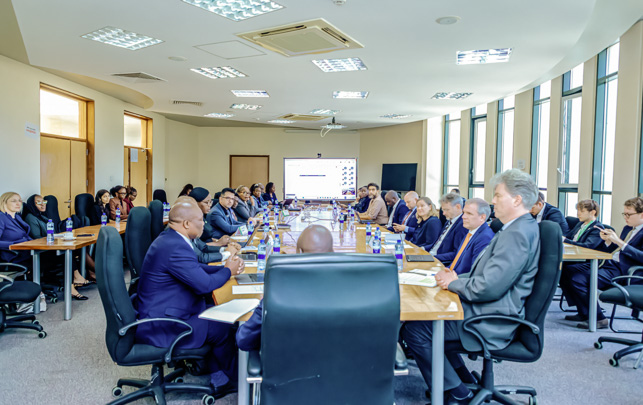
At the official launch of the second AI4EAC Innovation Challenge in Arusha, Tanzania, Prof. Eric Sax discussed the role of AI in education, research, and the economy in East Africa with international partners.
Read more here...
How can wind be measured without physical contact? Lintao Toni Fan’s dissertation addresses this question. The study examined an optical measurement method that uses particles already present in the air to determine wind parameters.
Click here for more information...
At the 2026 Student Forum, students and researchers from ITIV and Tongji University exchanged ideas on current research in smart technologies and sustainable development. In addition to technical presentations, the program included lab tours and discussions with industry representatives.
click here for more...
Vladimir Sidorenko has successfully completed his doctorate at ITIV. In his dissertation, he developed a novel real-time network architecture for distributed measurement systems that enables time synchronization with an accuracy of just 43 picoseconds and is already being used in the operational phase of the CBM experiment at the FAIR accelerator.
Read more here...
The IEEE Computer Society Annual Symposium on VLSI (ISVLSI) 2026 took place from July 7 to 10, 2026, in Kolkata, India. This international conference is one of the leading courses in the divisions of VLSI systems, chip design, design automation, hardware security, and embedded systems, bringing together researchers from academia and industry around the world.
All the details here...
A demonstration vehicle from the CeCaS (Central Car Server) research project has arrived at ITIV. It showcases key findings from the collaborative project funded by the Federal Ministry and will be used in the future for demonstrations, courses, and public outreach.
Read more...
A team of staff members from KIT's Institute for Information Processing Technology (ITIV) and the FZI Research Center for Information Technology completed a driving training course with 12-meter-long city buses at the Munich Transport Authority (MVG).
Click here for the article...