

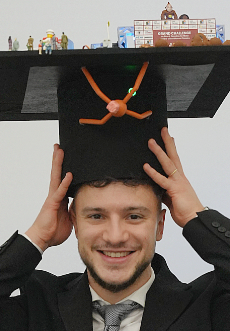
M. Sc. Alexandru Vasilache
- Exam Date: November 20, 2025
- Dissertation Topic:"Software-Level Sparsity Optimization for Low-Power Spiking Neural Networks"
- Group: Prof. Becker
- vasilache ∂does-not-exist.fzi de
Corrector: Prof. Dr. Yulia Sandamirskaya (ZHAW Zürcher Hochschule für Angewandte Wissenschaften)
Summary of the Dissertation
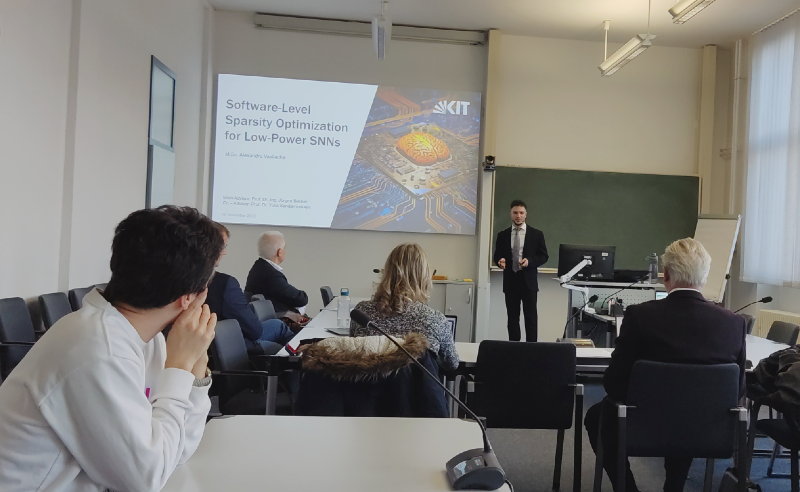

Modern artificial intelligence is very powerful, but it also consumes a lot of energy, which limits its use in mobile devices such as robots or biomedical implants.
Alexandru Vasilache’s dissertation addresses this problem by developing software methods to optimize so-called spiking neural networks (SNNs), which operate particularly energy-efficiently by mimicking the brain.
The methods developed specifically target unnecessary neural activity and connections, thereby enabling significant energy savings, which allows for the use of complex AI directly on the end device.
We warmly congratulate Alexandru Vasilache on this achievement!

Neuromorphic Computing
Neuromorphic computing mimics the structure of the human brain by replicating the spike activity of individual neurons, which offers the flexibility to simulate only the active neurons in order to achieve extreme computational efficiency. This is further enhanced by the binary information transmission paradigm represented by a spike, resulting in a dramatic reduction in memory, energy, and computational requirements. The simulation of individual neurons also enables the implementation of biologically plausible learning methods that facilitate local learning.

Embodied Intelligence
Embodied intelligence focuses on the integration of physical robot bodies with cognitive processes. This approach integrates sensory perception, motor control, and cognition, and mimics how living organisms interact with and adapt to their environment. Systems with embodied intelligence use real-world experiences as a crucial component of their cognitive processes and enable adaptive behavior and learning through direct interaction with the physical environment.

Generalist AI
Unlike specialized AI, which excels only in specific divisions, generalist AI, or Artificial General Intelligence (AGI), targets replicating human-like cognitive abilities for learning and handling multiple tasks. At the heart of AGI is the ability to generalize—that is, to learn from past experiences and apply that knowledge to new, unknown situations. This ability to continuously learn from experience without having to unlearn previous information is also known as continual learning.