

Model-Based Control Design for a Highway Pilot, Including Its Safety Analysis and Validation in a Full-Vehicle Simulation
- Type:Masterarbeit
- Date:assigned
- Tutor:
M. Eng. Jannis Erz (Externer Doktorand)
Model-Based Control Design for a Highway Pilot, Including Its Safety Analysis and Validation in a Full-Vehicle Simulation
Context
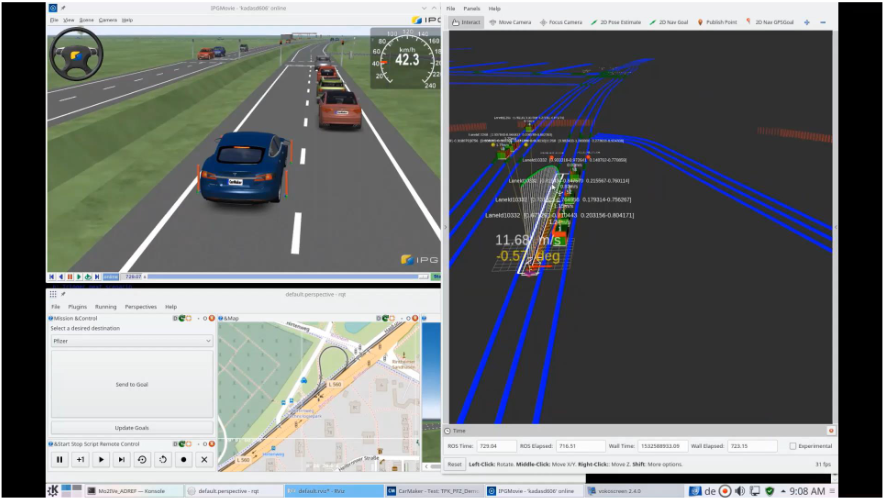
Ensuring the safety of automated vehicles, which rely, among other things, on deep learning using multilayer artificial neural networks, can be considered one of the key factors in their market introduction. This presents the challenge of systematically and methodically designing, as well as conducting safety-related analysis and validation of, control systems for the automated longitudinal and lateral guidance of these vehicles. In the development of such systems, the operational design domain—and in particular its physical characteristics, such as traffic, road conditions, or weather conditions—plays an increasingly important role. In this context, the dynamic behavior of the control loops along the vehicle’s longitudinal and lateral axes is heavily dependent on the specified operational design domain. These physical effects must be identified during the design of the vehicle’s internal control systems and appropriately accounted for using a top-down approach.
The objective of this thesis is, on the one hand, the model-based and methodical design of a cascaded control loop architecture for the longitudinal and lateral control of an automated vehicle, using the Highway Pilot as an example. The design of the control loop architecture is to be carried out using a hierarchical decomposition of the vehicle architecture. Subsequently, the subsystems derived from the decomposition will each undergo a control behavior analysis in relation to the specified operating range (highway section). Furthermore, the designed control loop architecture is to be integrated into a full-vehicle model with a simulated 3D environment that represents the specified operating range (highway section) and analyzed and validated from a safety perspective using defined test scenarios. Finally, the model development methodology applied to the control loop design is to be evaluated.
The thesis may be completed either at Robert Bosch GmbH in Ludwigsburg or directly at ITIV.
Research
Objective
- Literature review on the state of the art in science and technology regarding the control of automated vehicles
- Model-based and methodological design of the longitudinal and lateral control loop architecture of a fully automated vehicle using the Highway Pilot as an example, with explicit consideration of the defined operating range (MATLAB/Simulink)
- Commissioning and integration of the longitudinal and lateral control loop architecture into the overall vehicle simulation environment (IPG CarMaker)
- Safety analysis and validation of the longitudinal and lateral control loop architecture in the overall vehicle simulation environment (IPG CarMaker)
- Evaluation of the model development methodology for the design of the longitudinal and lateral control loop architecture
- The focus of the thesis can be adjusted upon consultation and depending on the student’s interests
Prerequisites
- Ability to work independently and in a structured manner
- Knowledge of control systems for multi-variable systems and vehicle dynamics is desirable
- Knowledge of MATLAB/Simulink is preferred, and familiarity with IPG CarMaker is desirable
- Degree programs: Electrical Engineering, Mechatronics, Mechanical Engineering, Computer Science, or similar fields