


M. Sc. Matthias Diehl
- 04.11.2025
- System for recording blood pressure by measuring pressure in the external auditory canal
- Group: Prof. Stork
- diehl ∂does-not-exist.fzi de
Corrector: apl. Prof. Dr. med. Christian Pylatiuk
Summary of the dissertation

As part of this work, a new approach to continuous, non-invasive blood pressure measurement in the ear canal was investigated. The aim is to support the early detection and treatment of cardiovascular diseases.
For this purpose, a miniaturized sensor system in the form of an individually adapted earmould with integrated measurement technology was implemented, combined with adaptive pressure control and artifact-resistant algorithms for blood pressure prediction.
Validation was carried out using controlled artifact scenarios as well as in clinical cardiac catheter examinations. The results show that the system has the potential to enable continuous monitoring of cardiovascular parameters in practice.
We would like to congratulate Matthias Diehl on this success!
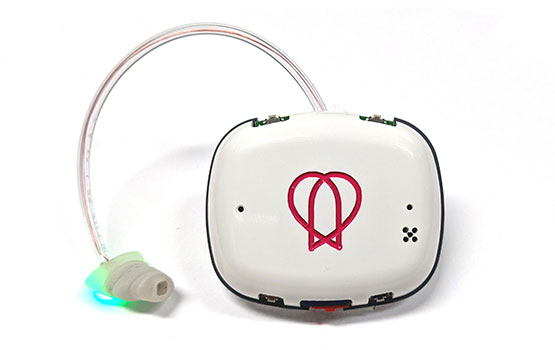
Innovative blood pressure measurement in the ear canal
Demographic change is resulting in an ageing society in which high blood pressure is becoming a widespread disease. Continuous monitoring for targeted treatment is hardly possible on an outpatient basis. The development of an electronic microsystem for permanent, non-invasive blood pressure measurement in the ear should make this possible in the future. The measurement is carried out by actively increasing the pressure in a sealed air chamber in the external auditory canal. Such a system enables long-term, stress-free measurement of blood pressure and thus represents an enormous advance in the diagnosis and treatment of cardiovascular diseases.
Networked sensor technology
Wearables are already an integral part of our daily lives and optically record our heart rate on our wrists, for example. The progress of available sensor technology with high resolution and ever lower power consumption is constantly advancing. However, the sensors usually work independently and can only be combined at a high level of abstraction. A considerable gain in knowledge could be achieved by precisely coordinating different wireless sensor nodes. For example, by precisely synchronizing the timing of an ECG belt with a pulse meter on the wrist, the pulse transit time through the body can be determined, which provides information about the vascular condition. By synchronizing and networking two individual sensors, a new, additional sensor value can be recorded.
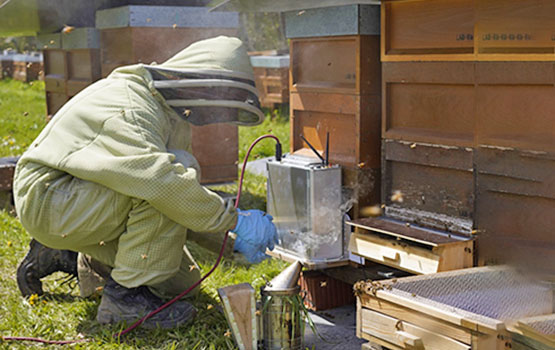
Bees as biosensors
The environment is changing due to human influences and the concrete impact of individual measures on biodiversity is usually not foreseeable. We can gain detailed insights into the behavior of pollinator insects through image processing on the beehive. In this way, the bee can be used as a sensor to explore the synergetic mechanisms of action of agriculture and pollinator insects. With the help of various algorithms for feature extraction based on local, multisensory raw data, pattern recognition using AI methods is being developed and trained in various feasibility studies.